Work                |

            Information      |


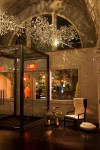
            Mirror Chandelier |


For Studio Roso |


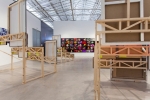
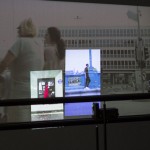
An instillation for the loby in the new Ames Hotel in Boston.  Structural analysis, engineering consultation and detail design. |


            Motion Mobiles |


For Michael Anastassiades |


A series of kinetic luminaries which move via concealed motors and solenoids.  The constituent components are modular to allow for a flexibility of configuration.  Precision gearmotors and innovative joints allow elements to both rotate and transmit power. |


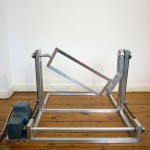
            Rotational molding shoe machine |


For Marloes Ten Bhömer |


This machine was designed to mold footwear for Marloes Ten Bhömer.  The movement of the machine is based on industrial rotational molding machines but is achieved by a custom designed mechanism. |


Exhibited at the Design Museum, London.  2009 |

Exhibited at the Krannert Art Museum.  2009 |


            The MacGuffin Library |


For Onkar Kular and Noam Toran |


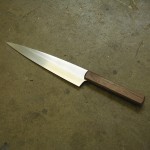
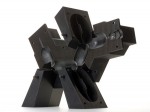
A term attributed to Hitchcock the MacGuffin is a cinematic plot device, usually an object, that serves to set and keep the story in motion despite lacking intrinsic importance.  For this project, the MacGuffin is seen as a unique object typology, existing within the constraints of cinema, and defined in shape and function to achieve the singular purpose of driving a filmic narrative. |


Working from film synopsis, authored by and Kular and Toran, objects were designed for the MacGuffin Library. |


Exhibited at Somerset House, London.  2008 |

Photographs by Sylvain Deleu |


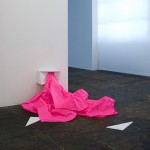
            Perfect Alignment, from Do you want to replace the existing normal? |


For Michael Anastassiades, Anthony Dunne and Fiona Raby |


Do you want to replace the existing normal? is a range of hypothetical products with the goal of generating debate about contemporary issues. |


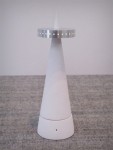
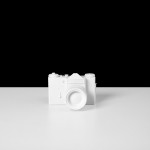
When Perfect Alignment is purchased, the user programs his or her horoscope into it.  On key astrological dates, a pink fabric crystal explodes form the box and rapidly deflates.  What happens next is up to the owner. |


Exhibited at MOMA, New York.  2008 |


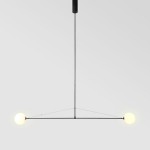
            Mobile Chandelier |


For Michael Anastassiades |


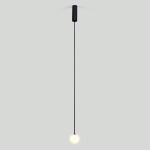
All the elements of this chandelier are in perfect balanced. The use of pivoting joints allowing for a dynamic reconfiguration of the elements without having to disconnect the luminaries. |


            Obsolete – Machine no 1 |


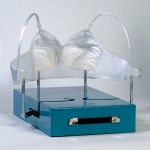
Obsolete – Machine no 1 is developed to resemble a demonstrative device as would be commonly seen in science or natural history museums.  In this case, the work mechanically displays the engineering principles of a brassiere.  When initiated the machine demonstrates the principles of both clasp disengagement and brassiere removal.  Following a short pause the machine then re-secures the bra ready for the next demonstration. | 

Purposefully didactic and comedic in its expression, the work is inspired by accounts of repressive post-war institutionalized sex education, but is conceived as a museum artefact from the future, demonstrating an obsolete behaviour brought about by developments in genetic engineering an plastic surgery. |


In collaboration with Noam Toran |

Exhibited at the Luxembourg Musee d’Art Moderne.  2007 |

Photography by Andres Lejona |


            Prosthetic spy leg |


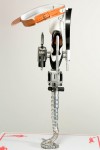
Commissioned by The Science Museum, London, the spy leg is a prospective design for the secret agent of the future.  The leg comprises of four different lower legs, tentacle, grappling hook, running and normal leg, that the user can switch between.  The attachments that are not currently being used are stored around the thigh.  The leg is based on expected developments in current technology or known areas of research. |


In collaboration with Noam Toran |

Exhibited at The Science Museum, London.  2007 |


            Designs for fragile personalities in anxious times |


For Michael Anastassiades, Anthony Dunne and Fiona Raby |


Technical consultant for the fabrication and operation of several pieces of kinetic furniture. |


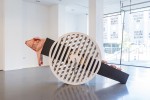
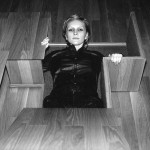
There are three versions of the Hide Away Furniture. They are for people who are afraid of being abducted. Each opens in a surprising way without disturbing objects displayed on their surfaces. Their outside appearances say little about how they are made or used, they attempt to blend in with their surroundings. The interiors are lined with felt to muffle sounds. Each of the pieces is designed around a specific pose. The poses encourage the occupant to feel in control, proud and comfortable, the opposite of a foetal position which would make them feel like a victim. The poses also generate an unusual geometry helping to disguise the fact they can be occupied. |


Photography by Jason Evans |